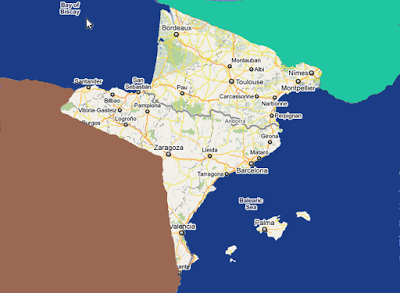
PYRENEAN ISTHMUS AND PERIPHERIA

PYRENEAN ISTHMUS AND PERIPHERIA

2012-03-17

FORMER SOVEREIGN STATES OF THE PYRENEAN ISTHMUS (III).

KINGDOM OF ARAGON


The Kingdom of Aragon (Aragonese: Reino d'Aragón), was a medieval and early modern kingdom in the Pyrenean istmus.


History

Independent kingdom

This kingdom was originally a Frankish feudal county around the city of Jaca, which in the first half of the 8th century became a vassal state of the kingdom of Pamplona (later Nabarre), its own dynasty of counts ending without male heir in 922.

On the death of Sancho III of Nabarre in 1035, the Kingdom of Nabarre was divided in to three parts: (1) Nabarre with some Basque lands, (2) Castile and (3) Sobrarbe, Ribagorza and Aragon. As the most important Christian monarch in the Pyrenean isthmus and the King of all Nabarre, each of his three lands were converted into a Kingdom. Sancho's son Gonzalo inherited Sobrarbe and Ribagorza, but Gonzalo was killed soon after and all the land he owned went to his illegitimate brother Ramiro, creating the future Kingdom of Aragon.

By defeating his brother, Ramiro achieved virtual independence for Aragon. As the kingdom expanded to the south, conquering land from Al Andalus, the capital city moved from Jaca to Huesca (1096), and later to Zaragoza (1118). By 1285 the southernmost areas of Aragon had been taken from the Moors.

Dynastic union with Catalonia


2012-03-16

LAST WEEK'S SPORTS IN THE PYRENEAN ISTHMUS

2012-03-12


STANDINGS PYRENALLIGA I. MEN. FOOTBALL SOCCER.

STANDINGS......................G.......W.......D.......L.......GF.......GA..........POINTS

1....BARCELONA.................26.......18.......6.......2........75.......19..............75
2...VALENCIA......................26.......12.......8.......6........40.......31..............54
3....MONTPELHIER..............27.......17.......6.......4........52.......26..............53
4....OSASUNA.....................26.........9......11.......6........31.......40..............48
5....ATHLETIC.....................26.........9.......10......7........42.......34..............47
6..MALLORCA.....................26.........7........9.....10........26.......32..............43
7....TOLOSA........................27.......12........8.......7........29.......24..............42
8......ESPANYOL.................26........10........6......10........32.......35..............41
9....LEVANTE......................26........11........5......10........37.......37..............40
10....GIRONDINS.................27........10........9.......8.........33.......30..............38
11....ERREALA....................26..........9........6......11........29.......35..............37
12...RACING........................26..........4......12......10........21.......35..............34
13....VILLARREAL................26.........6........9......11........27.......40..............29
14...SARAGOSSA................26.........4........6......16........21.......49..............27


2012-03-12


STANDINGS PYRENELLIGA 2011-2012. WOMEN.

STANDINGS.................................G.....W.....D.....L.....GF.....GA.....POINTS

1...BARCELONA..........................24.....22.....1......1.......87.......15........85
2...ATHLETIC...............................24.....20.....3......1.......77......16........82
3...ESPANYOL.............................24.....17.....4......3.......86......23........69
4...LEVANTE................................24.....13.....7......4.......41......23........59
5...ERREALA................................24.....12.....4......8.......38......29........47
6...PRAINSA ZARAGOZA..............24.....10......4....10.......52......51........43
7...SANT GABRIEL........................24......9.....4.....11.......43......41........36
8...MONTPELHIER........................16.....11......3......2.......48......11........34
9....COLLERENSE.........................24......8......3.....13......41......67........34
10..L'ESTARTIT.............................24......5......5.....14.......29......49........28
11...LAGUNAK...............................24......5......4.....15......21......49........23
12..VALENCIA...............................24......6......1.....17.......27......63........23
13..RODES....................................14......5......2......7.......19......23........19
14..REOCIN RACING.....................24......2......1.....21.......27......93..........9
15..MURETH.................................15......1......2.....12........11......51..........6


2012-03-12


STANDINGS PYRENALLIGA II. MEN. FOOTBALL SOCCER.

STANDINGS...........................G......W......D......L.....GF.......GA.......POINTS

1..ELS.................................28.......14......4.....10......43..........30...........55
2..HERCULES......................28.......15......3.....10......30..........23...........54
3..NUMANTIA.......................28......10.....10......8......35..........32...........46
4..CLARMONT FOOT............26.......12......8......6......31..........21...........46
5..BARCELONA ATHLETIC....28........9......9.....10......41..........33...........42
6..SABADELL.......................28........9.......9....10......31..........42...........41
7..ISTRES............................27.......11......6.....10......40..........34...........39
8..VILLARREAL B.................28.........8......8.....12......37..........45...........39
9..HUESCA...........................28.........6......8.....14......30..........44...........31
10..ARLE-AVINHON...............26.........7......9.....10......27..........38...........29
11...GIRONA.........................28.........5......8.....15......32..........48...........28
12..GIMNASTIC....................28.........3......9.....16......19..........37...........27


2012-03-12


HOW ARE OUR RUGBY TEAMS DOING IN THE TOP 14. MEN.

STANDINGS........................G.......W.......D........L........PF.........PA.........POINTS

1...TOLOSA..........................20......16........1........3.......508........328..............73
2...CLARMONT.....................20.......15........2........3.......478........264..............69
3...Tolon...............................20........11........4........5.......448........285..............58
4...MONTPELHIER...............20........11........1........8.......453.........390.............52
5...CASTRAS.......................20........10........3........7.......412........384..............51
6...Racing-Metro 92...............20........10........1........9.......428.........411.............49
7...StadeFrancais..................20.........9........2........9.......435.........448.............47
8...AGEN..............................20........10........1........9.......362........381..............44

9...BORDEU..........................20........8........0.......12.......353.........481.............37
10...Briva...............................20........6........1.......13.......319.........310.............37
11..PERPINYA......................20.........6........2.......12.......326.........436.............34
12..MIARRITZE......................20........6........2.......12.......302.........424.............34
13..BAIONA...........................20........5........3.......12.......347.........481.............30
14..Lyon OU...........................20........4........3.......13.......270.........418.............26


2012-03-12

HOW DID OUR FOOTBALL TEAMS FARE IN THE EIGHTS FINALS OF THE CHAMPIONS LEAGUE?

BARCELONA won in Germany against the Bayern Leverkusen its first of two games 1-3. And also won in at home 7-1. Therefore, BARCELONA becomes a quarter finalist in the Champions League.


2012-03-15

HOW DID OUR FOOTBALL TEAMS FARE IN THE EIGHTHS FINALS OF THE EUROPEAN LEAGUE?

ATHLETIC won in England against the Manchester United its first of two games 2 - 3. And Athletic won again at home against the Manchester United 2-1.

VALENCIA won at home against the PSV its first of two games 4 - 2. And Valencia tied its second game in Holland against the PSV 1-1.

Then, ATHLETIC and VALENCIA passed to the next round of quarterfinals in the Europe Cup tournament.


2012-03-15

FORMER SOVEREIGN STATES OF THE PYRENEAN ISTHMUS (II).

REPUBLIC OF GOUST

Goust is a hamlet in the Pyrenean isthmus, of southeastern Bearn. It was never formally annexed by anybody else, so even as late as the 19th century, visitors described it as an independent rpublic. Noted for its centenarians, one pensioner was reported to have reached the age of 123. Its inhabitants speak Bearnese and French. They are mostly Catholics.


Geography

1853 view of Goust and the Pont d'Enfer.
Goust is located on the territory of the commune of Laruns. It occupies one square mile on a plateau at the southern (upper) end of the valley of the Gave d'Ossau in the Western Pyrenean isthmus, across the river from Eaux-Chaudes. At an elevation of 995 m/3264 ft, it is accessible only by a narrow mountain footpath across the Pont d'Enfer ("Bridge of Hell"). The nearest town is Laruns in the valley below.

The community is made up of 10-12 households, with a population fluctuating between 50 and 150 residents. The traditional economy was based on animal husbandry, wool, and silk production, augmented more recently by tourism. All baptisms, weddings, and burials are performed at the Catholic Church in Laruns.
Due to its isolated situation, the inhabitants of Goust evolved a curious funeral custom: the deceased was placed in a coffin and sent down the mountainside via a specially-constructed chute, to be collected at the bottom for burial in the Laruns cemetery.


History

Self-governing for centuries, Goust's independence was allegedly recognized by its neighbors since at least 1648. The government consisted of a Council of Ancients composed of three to twelve citizens, who elected a President for a term of five years.


In 1896 the president reportedly proclaimed a ban on publication of any newspaper without executive authorization, which led to an uprising of the
citizens. Although never formally annexed, Goust has not recently asserted its claim to independence, so is de facto a part of the Pyrenean isthmus and generally recognized as such.

2012-03-13

CONGRATULATIONS ANDORRA

PREAMBLE OF ITS CONSTITUTION APPROVED ON MARCH 14TH, 1993, BY THE ANDORRAN PEOPLE BY DEMOCRATIC REFERENDUM

The Andorran People, with full liberty and independence, and in the exercise of their own sovereignty,
Conscious of the need to conform the institutional structure of Andorra to the new circumstances brought about by the evolution of the geographical, historical and socio-cultural environment in which it is situated, as well as of the need to regulate the relations which the institutions dating back to the Pareatges. shall have within this new legal framework,
Resolved of the need to be endowed with all the mechanisms leading to juridical security in the exercise of the fundamental rights of the individual, which, although always present and respected in the nature of Andorran society, have not received the protection of any kind of general laws,
Eager to use every endeavour to promote values such as liberty, justice, democracy and social progress, and to keep and strengthen the harmonious relations of Andorra with the rest of the world, and especially with the neighbouring countries, on the basis of mutual respect, co-existence and peace,
Willing to bring their collaboration and effort to all the common causes of mankind, and especially to those of preserving the integrity of the Earth and guaranteeing an environment fit for life for the coming generations,
Desiring that the motto "virtus, unita, fortior", which has presided over the peaceful journey of Andorra over its more than seven hundred years of history, may continue to be a completely valid principle and may always guide the conduct of Andorrans,
Approve the present Constitution, in the exercise of their sovereignty.

TITLE I

SOVEREIGNTY OF ANDORRA


Article 1


1. Andorra is a Democratic and Social independent State abiding by the Rule of Law. Its official name is Principat d'Andorra..


2. The Constitution proclaims that the action of the Andorran State is inspired by the principles of respect and promotion of liberty, equality, justice, tolerance, defence of human rights and dignity of the person.


3. Sovereignty is vested in the Andorran People, who exercise it through the different means of participation and by way of the institutions established in this Constitution.


4. The political system of Andorra is a parliamentary Coprincipat .


5. Andorra is composed of the Parròquies of Canillo, Encamp, Ordino, La Massana, Andorra la Vella, Sant Julià de Lòria and Escaldes-Engordany.


Article 2


1. Catalan is the official language of the State.


2. The national anthem, the State flag and the coat of arms of Andorra are the traditional ones.


3. Andorra la Vella is the capital of the State.


Article 3


1. The present Constitution, which is the highest rule of the legal system, binds all the public institutions as well as the individuals.


2. The Constitution recognizes the principles of equality, hierarchy, publicity of the judicial rules, non-retroactivity of the rules restricting individual rights or those that are unfavourable in their effect or sanction, juridical security, accountability of public institutions and prohibition of any kind of arbitrariness.


3. The universally recognized principles of international public law are incorporated into the legal system of Andorra.


4. The treaties and international agreements take effect in the legal system from the moment of their publication in the Butlletí Oficial del Principat d'Andorra and cannot be amended or repealed by law.

2012-03-12

FORMER SOVEREIGN STATES OF THE PYRENEAN ISTHMUS (I).


COUNTY OF FOIX


History

County of Foix in 1328 (Béarn is outside of the map).

House of Foix

Blason du comté de Foix.svg
The Counts of Foix flourished from the 11th to the 15th century. They were at first feudatories of the counts of Tolosa, but after the latter's defeat in the Cathar Crusade they succeeded in establishing their direct vassalage to the king of Nabarre.

During the 13th and 14th centuries the counts of Foix figured among the most powerful feudal nobles. Living on the borders of Andorra, having constant interaction with the kingdom of Nabarre, and in frequent communication with England through Gascony and Aquitania, they were in a position favorable to an assertion of independence, and acted more like the equals than the dependents of the kings of France and other kingdoms.

The title of count of Foix was first assumed by Roger of Foix (died ca. 1064), son of Bernard Roger of Couserans, who was a younger son of Roger I de Cominges, Count of Carcassonne, de Couserans et de Razés, when he inherited the town of Foix and the adjoining lands, which had hitherto formed part of the county of Carcassonne.

His grandson, Roger II, took part in the First Crusade in 1095 and was afterwards excommunicated by Pope Paschal II for seizing ecclesiastical property. Subsequently he appeased the anger of the church through rich donations, and when he died in 1125 he was succeeded by his son, Roger III, and his son, Roger Bernard I.

Roger-Bernard's only son, Raymond Roger, went to Palestine in 1190 and distinguished himself at the capture of Acre. He was afterwards engaged in the Albigensian Crusade defending the Cathars, and, on being accused of heresy, his lands were given to Simon IV de Montfort. Raymond Roger came to terms with the Church and recovered his estates before his death in 1223. He was a patron of the Provençal poets and a poet himself.

He was succeeded by his son, Roger Bernard II the Great, who assisted Raymond VII, Count of Tolosa, and the Albigenses in their resistance to the French kings, Louis VIII and Louis IX, was excommunicated on two occasions, and died in 1241.

His son, Roger IV, died in 1265 and was succeeded by his son, Roger Bernard III who, more famous as a poet than as a warrior, was taken prisoner both by Philip III of France and by Peter III of Aragon. He married Marguerite, daughter and heiress of Gaston VII, Viscount of Béarn, and he inherited Béarn and Nébouzan from his father-in-law in 1290, which led to the outbreak of a long feud between the Houses of Foix and Armagnac.

From 1278 the counts of Foix, and their legal successors, have also been Co-princes of Andorra.

House of Foix-Béarn

Castle of Foix towering above the town, with the Pyrenees behind.
Blason de Foix-Béarn.svg
The quarrel was continued under Roger Bernard's son and successor, Gaston I, who became count in 1302, inheriting both Foix and Béarn. Becoming embroiled with the French king, Philip IV, in consequence of the struggle with the count of Armagnac, Gaston was imprisoned in Paris. He quickly regained his freedom and accompanied King Louis X on an expedition into Flanders in 1315, and died on his return to Bearn in the same year.

His eldest son, Gaston II, made peace with the house of Armagnac and took part in various wars both in France and Spain, dying at Seville in 1343, when he was succeeded by his young son, Gaston III.

Gaston III (1331–1391), called Phoebus, was the most famous member of the House of Foix-Béarn. Like his father he assisted France in her struggle against England, being entrusted with the defence of the frontiers of Gascony.

When the French king, John II, favored the count of Armagnac, Gaston left his service and went to fight against the pagans of Prussia. Returning to Bearn around 1357, he delivered some noble ladies from the attacks of the adherents of the Jacquerie at Meaux, and was soon at war with the count of Armagnac.
Gaston Phoebus, from an early 15th century copy of his Livre de chasse.
During this struggle he also attacked the count of Poitiers, the royal representative in Languedoc, but owing to the intervention of Pope Innocent VI he made peace with the count in 1360. Gaston, however, continued to fight against the count of Armagnac, who, in 1362, was defeated and compelled to pay a ransom. This war lasted until 1377.

Early in 1380, the count was appointed governor of Languedoc, but when Charles VI succeeded Charles V as king later in the same year, this appointment was cancelled. Refusing, however, to heed the royal command, and supported by the communes of Languedoc, Gaston fought for about two years against John, duke of Berry, who had been chosen as his successor.

When he was bested in the combat, he abandoned the struggle and retired to his estates in Bearn, remaining neutral and independent. He then resided in Orthez, the capital of Béarn. In 1348 Gaston married Agnes, daughter of Philip, Count of Evreux (d. 1343), by his wife Jeanne II, queen of Nabarre. By Agnes, whom he divorced in 1373, he had an only son, Gaston, who met his death in 1381.

Gaston was very fond of hunting, but was not without a taste for art and literature. Several beautiful manuscripts are in existence which were executed by his orders, and he himself wrote a treatise on hunting, the Livre de chasse, known in English as The Hunting Book. Froissart, who gives a graphic description of his court and his manner of life at Orthez in Béarn, speaks enthusiastically of Gaston, saying: "I never saw one like him of personage, nor of so fair form, nor so well made, and again, in everything he was so perfect that he cannot be praised too much".

Left without legitimate sons, Gaston de Foix was easily persuaded to bequeath his lands to King Charles VI, who thus obtained Foix and Béarn when the count died at Orthez in 1391. Almost immediately after Gaston's death Charles granted the county of Foix to Matthew, Viscount of Castelbon, a descendant of Count Gaston I of Foix. When Matthew died without issue in 1398, his lands were seized by Archambault, Count of Grailly and Captal de Buch, the husband of Matthew's sister Isabella (d. 1426), who was confirmed as legitimate count of Foix in 1401.

House of Foix-Grailly

Armoiries Navarre Foix.png
Archambault's eldest son, John (ca. 1382–1436), who succeeded to his father's lands and titles in 1412, had married Jeanne in 1402, daughter of Charles III, king of Nabarre. Having served the king of France in Guyenne and the king of Aragon in Sardinia, John became the royal representative in Languedoc, when the old quarrel between Foix and Armagnac broke out again. During the struggle between the Burgundian party and the Armagnacs, he intrigued with both, and consequently was distrusted by the Dauphin, afterwards King Charles VII. Deserting the French cause, he then allied himself with Henry V of England. When Charles VII became king in 1423, he returned to his former allegiance and became the king's representative in Languedoc and Guyenne. He then assisted in suppressing the marauding bands which were devastating France, fought for Aragon against Castile, and aided his brother, the cardinal of Foix, to crush an insurgency in Aragon.

Peter, cardinal of Foix (1386–1464), was the fifth son of Archambault of Grailly, and was made archbishop of Arles in 1450. He took a prominent part in the struggle between the rival popes, and founded and endowed the Collège de Foix at Toulouse. The next count was John's son, Gaston IV of Foix, who married Leonora (died 1479), a daughter of John, king of Aragon and Nabarre. In 1447 he bought the viscounty of Narbonne, and having assisted King Charles VII in Guyenne, he was made a peer of France in 1458. In 1455 his father-in-law designated him as his successor in Nabarre, and Louis XI of France gave him the counties of Roussillon and Cerdagne, and made him his representative in Languedoc and Guyenne; but these marks of favor did not prevent him from joining a league against Louis in 1471.

His eldest son, Gaston, the husband of Madeleine, a daughter of Charles VII of France, died in 1470, and when Gaston IV died two years later, his lands descended to his grandson, Francis Phoebus (died 1483). Francis Phoebus became king of Nabarre in 1479 and was succeeded by his sister Catherine (died 1517), the wife of Jean d'Albret (d. 1516).

A younger son of Count Gaston IV was John (died 1500), who received the viscounty of Narbonne from his father and married Marie, a sister of the French king Louis XII. He was on good terms both with Louis XI and Louis XII, and on the death of his nephew Francis Phoebus in 1483, claimed the kingdom of Nabarre against Jean d'Albret and his wife, Catherine de Foix. The ensuing struggle lasted until 1497 when John renounced his claim. He left a son, Gaston de Foix (1489–1512), a distinguished French general, and a daughter, Germaine de Foix, who became the second wife of Ferdinand I of Spain.

In 1507, Gaston exchanged his viscounty of Narbonne with King Louis XII of France for the duchy of Nemours, and as duke of Nemours he took command of the French troops in Italy. After delivering Bologna and taking Brescia, Gaston encountered the troops of the Holy League at Ravenna in April 1512 and routed the enemy, but was killed during the pursuit.

There were also younger branches of the house of Foix-Grailly: the viscounts of Lautrec (descended from Pierre de Foix, younger son of Jean III); the Counts of Candale and Benauges (descended from Gaston de Foix, a younger son of Archemboult); the Counts of Gurson and Fleix and Viscounts of Meille (Jean de Foix, Comte de Meille, Gurson et Fleix, was a younger son of Jean de Foix, Earl of Kendal), and the Counts of Caraman, or Carmain, descended from Isabeau de Foix, Dame de Navailles (only child of Archambaud de Foix-Grailly, Baron de Navailles) and her husband Jean, Vicomte de Carmain, whose descendants adopted the name and arms of Foix.

Houses of Albret and the House of Bourbon

Armoiries Navarre-Albret.png
Blason Rois de France (1553-1610).svg
When Catherine, wife of Jean d'Albret, succeeded her brother Francis Phoebus, the House of Foix-Grailly was merged into that of Albret, and later into that of Bourbon with Henry III of Nabarre, son of Antoine de Bourbon and Jeanne d'Albret.
Henry III of Nabarre became King Henry IV of France in 1589. In 1607, he united to the French crown his personal fiefs that were under French sovereignty (i.e. County of Foix, Bigorre, Quatre-Vallées, and Nébouzan, but not Béarn and Lower Nabarre, which were sovereign countries outside of the kingdom of France), and so the county of Foix became part of the royal domain.
2012-03-09

HOW DID OUR FOOTBALL TEAMS FARE IN THE EIGHTHS FINALS OF THE EUROPEAN LEAGUE?

ATHLETIC won in England against the Manchester United its first of two games 2 - 3.

VALENCIA won at home against the PSV its first of two games 4 - 2.

2012-03-08

ARTURO JAIME CAMPION

ARTURO JAIME CAMPION


Writer and politician, born in Pamplona / Iruña in the Pyrenean Isthmus, on May 7, 1854, years later put into practice the laws of the Courts of Madrid, 1837, 1839 and 1841 that removed the Kingdom of Navarre to become province. This weighed heavily on Campion's life until his death in 1937.

At 19 years of age had already studied at the University of Oñate, Gipuzkoa, to continue later in Madrid, earning a degree in law at age 22 in 1876.
At 24, he published his first book Considerations on the issue Carlists in Navarre and Navarre (1876) and became friends with the scientist Antoine d'Abbadie , the writer Captain Duvoisin , linguist Prince Bonaparte , the historian Jean Jaurgain , the philosopher and poet Miguel de Unamuno and other prominent figures of the time. It also appears as an advocate and founder of the "Association of Navarra Euskara" and the initiative is launched from the columns of "La Paz" in Madrid and immediately picked Iturralde y Suit as collaborator.


At 26 published ballad Orreaga , dropped several dialects and sub-dialects for purposes of comparative linguistics (1880).

At 27 he began his first series of Basque stories later was to include in books under the title "Euskariana. Fantasy and Reality" (1881).

At 29, the Essay on the phonetic laws of language Euskara (1883).

At 30, he wrote a large Bascongada Grammar of the four literary dialects of the language Euskara (1884) with 893 p. and a complicated series of inserts of the conjugations of verbs in all treatments.

At 31, did the portrait Victor Hugo (1885).

At 35, he published the novel Don Garcia Almoravid , the subject of strong historic and dramatic (1889).

At 36, the first book in the very important series "Euskariana".

At 38, a new Euskariana , under the heading of "Fantasy and Reality" with his first novel-like productions.

At 39, entered the political arena with his book The Battle girl Mr. Nocedal (1893), this year being named Member of Parliament without being militant to any political party.

At 40, new Euskariana , then he revealed as an investigator who fully entered into the archives of the kingdom.

At 45, his second great novel, drama, Blacks and Whites (1898), which showed the influence of Unamuno's "Complete Works", Vol. VI. At 47, Euskara personality in history, law and literature (1901).

At 50, he acted as president of " Euskaltzaleen Biltzarra "in Irun (1904).
At 51, wrote his third Euskariana based on historical subjects of the country doing research in anthropological-psychological study of the Basque race (1905).
At 53, Political and literary discourses (1907).

At 54, Conference on Basque nationalism in Gernika, printed in 1908.

At 55, the great novel printed in two volumes La Bella Easo (1909).

At 56, published Euskaldun Origins of the People (1910).

At 60, helped in the "Geography of the Basque Country and Navarre" with a major study, Nabarra in his historical life , in which, he changed the course of the historiography of Navarre (1914).

At 63, new Euskariana series "Fantasy and Reality", which are the most valuable literary productions of the author (1918). Named this year's Honorary Chairman of the Society of Basque Studies Congress created in Oñate sponsored by four Basque provinces.

At 64, published an original work of The languages ​​and particularly of the baska as a tool of historical research (1919).

At 66, disclosed in Bilbao magazine "Hermes" the trial Is ugly or beautiful the Basque race? , commenting on the paintings of Basque painters of the time (1920).

At 68, new Euskariana , studies and historical research (1923).

At 72, the first volume of the Origins of euskaldun people .

At 74, is published in the aforementioned book in its historical life Nabarra (1927).

At 77, the second volume of Origins of the People Euskaldun (1931).

At 80, Eleventh Euskariana with first-hand historical research (1934).

At 82, twelfth Euskariana and third volume of Origins of the People Euskaldun , which was to remain unfinished (1936).


He died in 1937, left unpublished a Euskariana on "Language Arts euskaras", another on "History", and finally one called No Euskariana on art criticism and history. It is also known for a novel in progress, The Nun.


Campion was Academic of the Academy of the Basque Language, Correspondent of the Royal Academy of History, Moral and Political Sciences and the Academy of the Spanish Language. He was president for life of the Basque Studies Society and the entity -Esnalea Euskal .

Politically it is not possible to point Campion as a member of any political party but in his youth he felt federal Republican. Soon left his republicanism, with the fall of Castelar and the dissolution of Congress by General Pavia, but staid with his federalism formula that considered compatible with the state statutory law always respected until then. In his own words was left with the essential and the accidental rejects. It was no longer a Republican, nor monarchist, Carlist, fundamentalist, not even Basque nationalist. Was never affiliated to any party. His political activity started from the love of his Campionek Euskal Herriarekiko. He always felt Nabarran , he used to say, "I have always cheered my homeland and I intend to so until my death."

Campion's entire work is in favor of the slogan stamped on his books, " "Euskalerriaren Alde "(Pro Euskalerria). His will never failed. Even without knowing the Basque language, he learnt it His grammar knowledge was very much improved at that time. He had many clashes and violent disputes with the Carlists and even with the Basque nationalists, especially Goiri Arana. At 39 years old, faces in Congress with the minister Gamazo in bold and energetic debate. It was at that time, perhaps the only Christian member of Congress without a political statutory partisanship. He continued working in the task of achieving the restoration of "foralidad" of Navarre based in philological, legal, anthropological, historical, sociological, political, literary criticism and even cultivated musical and art studies.


He was a versatile man and very capable researcher and writer. He always wanted to know the truth and that caused him bitterness and disappointment, but never gave up. Instead, he searched the remedy with redoubled effort and lived in constant anxiety to the course of the increasingly adverse events. Arturo Jaime Campion was a Nabarran with Basque graft blood in his veins.

He began his literary career influenced by Spanish literature, bombastic and declamatory, and gradually evolved towards short phrase and the strong line, sometimes even violent. Some of his compositions are more pieces of jewelry: Gratxina, La Flor de Larralde, Sancho Garces, Yan Pier Bidart, The Bard of Izalzu ... His literary work begins with stories and legends and continues with the historical novel as was fashionable then, but more dramatic and less descriptive, strong, and less romantic than Navarro Villoslada, his countryman.

Historical research was his first order, thorough and objective as well as copious, as each volume of his "euskarianas" contains about 500 pages. This research shaped the literary work then too often. His famous Gossip Column of the history of Nabarre becomes the novel Don Garcia Almoravid and the study of the "Chanson de Roland" by Bedier, in his precious jewel Itzalzu The Bard . His novels Whites and Blacks and La Bella Easo are somewhat harsh realism and naturalistic at times. For this reason he had to support more than one adverse criticism for those passages labeled as somewhat crude for its time. Nothing mattered and he went on his way unperturbed. Sample of this naturalism is, for example his novella A Night in Zugarramurd.

Campion, enthusiastic and tireless, tenacious and very methodical historian, more literate and more generally Basque as their first publications were almost narrowly Navarre the province. "I learned Euskera following an incident in Parliament", he once said. He spoke and wrote in Euskera enough to lead by example. He began by Orreaga , legend Denbora antziñakoen ondo esanak Euskera and translation of Tolstoy's tale entitled ta Malaxka Akulina . There are also cases of letters from him in Euskera.

In Spanish literature he never found no echo because of the statutory emphasis of all his works. Only the Countess of Pardo Bazán and the wayward Unamuno devoted rave, something rather rare in the latter.

Legend Dembora antziñakoen translated it into French-Delbasc Fuché including it in the book "Contes espagnoles." Pedro Mari was translated into German by Mrs. Elsa Otten (two editions) and the novel Blacks and Whites also into German by Karl Voigt, although apparently was never published because of the war.
In recent years, have been translated into Euskera La Flor de Larralde , by Domingo Aguirre, Pedro Mari , by P. Just Mari Mokoroa and several short stories by Dz. Zunzunegui, Zarautz. The Bard of Itzalzu has been staged by Ruiz Anibarro and represented in Buenos Aires, and the adaptation of Garces Sancho became the opera "Zigor" with the teacherEscudero. But Campion's own preference was for his novel La Bella Easo , because in it, he said, "is represented everything I want it to be and do not want it to be, what I love and what I hate: This book is my whole thougt. "

In life he was known as Don Arturo, and was subject of two major tributes and others less important. His bust in bronze, the work of Orduna, presided at the Library of the Society of Basque Studies and the Institute of Julio de Urquijo, Donostia-San Sebastian.


He died in Donostia, in the Pyrenean Isthmus, in August 18th. 1937. . The outbreak of civil war found him blind but fully lucid.

That day, a statement appeared in "El Diario de Navarra" a rumor speculating about Campion's possible participation on the rebel side of the Spanish Civil War...but Bernardo Estornes who knew him and visited him in those dark days denied it. This is the story of Estornés in his memoirs ( Memories. Memories and adventures of a century , Auñamendi, Donostia, No. 143-144 (1996), 163-165):

IN MEMORY AND IN HONOR OF ARTHUR DON CAMPION.

"Following the last war have been attributed to Don Arturo Campion attitudes strongly disagree with his long life of militant Basque. Among them stands out for its importance to the letter dated 14 September 1936 received the Diario de Navarra. Reads :

Donostia, September 14, 1936.

I have the pleasure to record that, freed the city of Red tyranny, let me say, while my most energetic protest by the unqualified come from Basque nationalism, my unwavering commitment to the National Board of Burgos. Arturo Campion.

But it so happens that, days before the date of this letter, the day after the occupation of the city by Franco, a relative of Campion called me by phone to discuss an urgent matter. I then found myself in Zarauz and immediately went to Donostia in person to the home of Don Arturo. On the way I heard some shots. I went across the railroad tracks and headed towards the famous village "Enea Emilia" in Ategorrieta. Leaving in the window an ikurriña waving, which meant in those tragic moments, to some extent, a certain security.

I received the widow of Vila, a soldier who had been murdered in the street with his minor child. A horrendous crime. Had surrendered the headquarters of Loyola, to be among the surrendered two nephews of Mr. Arthur if I remember correctly. Their lives were in danger and had to do something for them. Presumably a painful picture. The widow, distraught, crying, held and maintained that her husband had never been involved in anything. They accused him of having caught firing from a window or roof. The other person present there was Don Arturo, blind for several years, destroyed health, diabetes, cracked voice, and, above all, almost centennial.

He repeated words and harsh sentencing for rebellion. I listened in awe. The lifetime Campion lucid, energetic, struggling in an uncontrollable anxiety. For Campion loved dearly his nephews to whom he dedicated, in its day, some of the most pressing literary compositions. Don Arthur was a widower for many years and had no children. So, their families were their closest relatives.

I do not know what would have happened that September 14 de1936, but I can imagine. It was the height of the violence and they were not going to stop in small minutiae. The fight propaganda played its climax. I do not prejudge anything about that statement. Allow me, however, some comments.

First, the rush to write this note the day after the occupation of the city.

Second, the nature of it and his writing, which is unusual prose of Don Arturo.
"I have the pleasure" to leave proof. Yes, Arturo took great pleasure. "Liberated" the city. "Red Tyranny." "My strongest protest." "Unspeakable act". And above all, 'Accession unwavering, "the National Board of Burgos." It just does not prove anything, that writing was indeed a hoax, nothing else.