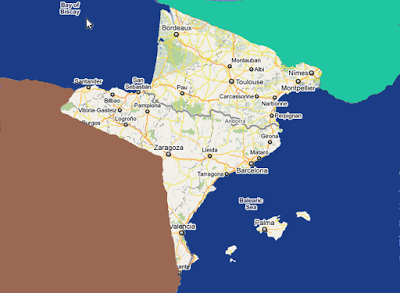
PYRENEAN ISTHMUS AND PERIPHERIA

PYRENEAN ISTHMUS AND PERIPHERIA
Showing posts with label PYRENEAN HISTORY. Show all posts

2014-11-03

NOVEMBER 9TH, 2014 IS THE DATE OF THE PARTICIPATORY PROCESS OF CATALONIA ON THE EAST COAST OF THE PYRENEAN ISTHMUS.


For those who are not aware of what is going on in Catalonia these days, this video shows an interview with one of the leaders of a political party that with some others have built up a powerful movement for independence of Catalonia. They are trying to set up a pacific and democratic participatory process by the means of voting in a referendum among the the seven million Catalans.

The video is in Spanish, but there are interesting images of the magnitude of this movement. The interview is about a discussion on what the alternatives are, since the Spanish government has decided to forbid such democratic act. And this leader is calling for pacific civil disobedience. They are determined  to vote...... no matter what !!

Once again, it is natural that ancient Pyrenean countries claim back their ripped off  sovereignty by the conquerors, forcefully. We shall keep informing about this crucial development due for Sunday


https://www.youtube.com/watch?v=PdsSYgUViR0

If the link does not work when clicked, please make a copy and paste of it in your browser to watch the video.

2014-10-28

SIGNIFICANT SOVEREIGN MOVEMENT ON THE EAST COAST OF THE PYRENEAN ISTHMUS

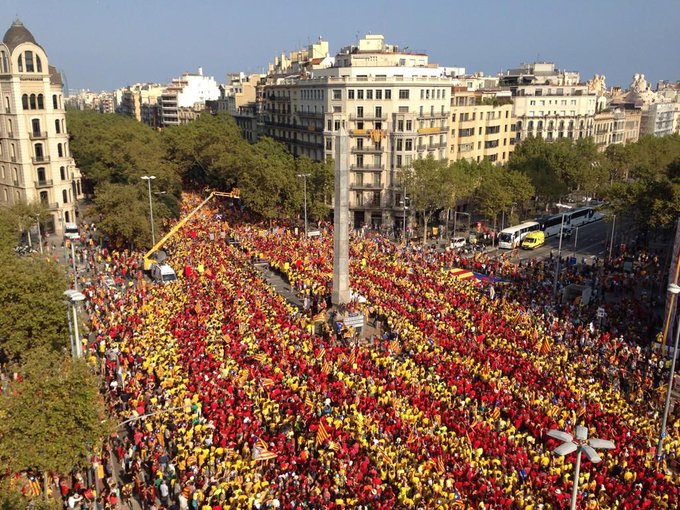
It seems like the Pyrenean nations based on their Pyrenean Laws and Rights,  as well as cultures are rising like baker's yeast all over the isthmus. This is nothing new, after all, that is the way it used to be, during periods of feudalism and well before that, considerable number of small independent countries (known historically as kingdoms, ducats, counties, principalities, etc.),

With the numerous waves of invasions from South to North and from East to West, all those small national entities were constantly eroded and even partially or totally destroyed. But apparently, never died off. Their dormant stage remained there, and now in this new cycle of history are coming back with formidable strength. Catalonia is a clear example of that.

View image on Twitter


http://www.theguardian.com/world/2014/sep/12/catalan-independence-referendum-demonstration-in-pictures

http://www.theguardian.com/world/2014/sep/12/catalan-independence-referendum-demonstration-in-pictures

2014-10-09

ANDORRA, THE LAST INDEPENDENT SURVIVOR OF THE MARCH STATES


http://workmall.com/wfb2001/andorra/andorra_history.html


Andorra History
http://workmall.com/wfb2001/andorra/andorra_history.html
Source: US State Department
      Andorra is the last independent survivor of the March states, a number of buffer states created by Charlemagne to keep the Muslim Moors from advancing into Christian France. Tradition holds that Charlemagne granted a charter to the Andorran people in return for their fighting the Moors. In the 800s, Charlemagne's grandson, Charles the Bald, made Count of Urgell overlord of Andorra. A descendant of the count later gave the lands to the diocese of Urgell, headed by Bishop of Seu d'Urgell.

      In the 11th century, fearing military action by neighboring lords, the bishop placed himself under the protection of the Lord of Caboet, a Spanish nobleman. Later, the Count of Foix, a French noble, became heir to Lord Caboet through marriage, and a dispute arose between the French Count and the Spanish bishop over Andorra.

      In 1278, the conflict was resolved by the signing of a pareage, which provided that Andorra's sovereignty be shared between the Count of Foix and the Bishop of Seu d'Urgell of Spain. The pareage, a feudal institution recognizing the principle of equality of rights shared by two rulers, gave the small state its territory and political form.

      Over the years, the title was passed between French and Spanish rule until, in the reign of the French King Henry IV, an edict in 1607 established the head of the French state and the Bishop of Urgell as co-princes of Andorra.

      Given its relative isolation, Andorra has existed outside the mainstream of European history, with few ties to countries other than France and Spain. In recent times, however, its thriving tourist industry along with developments in transportation and communications have removed the country from its isolation.


      NOTE: The information regarding Andorra on this page is re-published from the US State Department. No claims are made regarding the accuracy of Andorra History information contained here. All suggestions for corrections of any errors about Andorra History should be addressed to the State Department

    2012-06-17

    FORMER SOVEREIGN STATES OF THE PYRENEAN ISTHMUS (X).

    KINGDOM OF ILTRIDA AND ILERDA 


    In ancient times the city, named Iltrida and Ilerda, was the chief city of the Ilergetes, an Iberian tribe.  Indibil, king of the Ilergetes, and Mandoni, king of the Ausetanes, defended it against the Roman invasion.


                                                                   Flag


    Under the Romans, the city was incorporated into the Roman province of Hispania Tarraconensis, and was a place of considerable importance, historically as well as geographically. It stood upon an eminence, on the right (west) bank of the river Sicoris (the modern Segre), the principal tributary of the Ebre, and some distance above its confluence with the Cinga (modern Cinca); thus commanding the country between those rivers, as well as the great road from Tarraco (modern Tarragona), the provincial capital, in the Pyrenean Isthmus, which here crossed the Sicoris.


    File:Coat of Arms of Lleida.svg
                                                 
                                                           Coat of arms


    Its situation induced the legates of Pompey in the isthmus to make it the key of their defense against Caesar, in the first year of the Civil War (49 BCE). Afranius and Marcus Petreius threw themselves into the place with five legions; and their siege by Caesar himself (Battle of Ilerda), as narrated in his own words, forms one of the most interesting passages of military history. The resources exhibited by the great general, in a contest where the formation of the district and the very elements of nature seemed in league with his enemies, have been frequently extolled; but no epitome can do justice to the campaign. It ended by the capitulation of Afranius and Petreius, who were conquered as much by Caesar's generosity as by his strategy.In consequence of the battle, the Latin phrase Ilerdam videas is said to have been used by people who wanted to cast bad luck on someone else.


    Under the Roman empire, Ilerda was a very flourishing city, and a municipium. It minted its own coins. It had a fine stone bridge over the Sicoris, (the bridge was so sturdy that its foundations support a bridge to this day). In the time of Ausonius the city had fallen into decay; but it rose again into importance in the Middle Ages.


    It was part of Visigothic and Muslim Hispania until it was conquered from the Moors by the Count Ramon Berenguer IV of Barcelona in 1149. It used to be the seat of a major university, the oldest in the Crown of Aragon, until 1717, when it was moved by Philip V to the nearby town of Cervera.

    During the Reapers' War, Lleida was occupied by the French and rebel forces. In 1644 the city was conquered by the Spanish under D. Felipe da Silva.

    2012-05-19

    FORMER SOVEREIGN STATES OF THE PYRENEAN ISTHMUS (IX).


    TAIFA OF ZARAGOZA

    The taifa of Zaragoza was an independent Muslim state in Moorish Al-Andalus, in the Pyrenean Isthmus,  which was established in 1018 as one of the taifa kingdoms, with its capital in islamic Saraqusta (Zaragoza) city. The zaragoza's taifa emerged in the 11th century following the destruction of the Caliphate of Córdoba in the Moorish Iberian Peninsula.

    During the first three decades of this period (1018–1038) the city was ruled by the Banu Tujibi. They were replaced by the Banu Hud, who had to deal with a complicated alliance with El Cid of Valencia and his Castilian Masters against the Almoravids who managed to bring the Taifas Emirates under their control. After the death of El Cid, his kingdom was conquered by the Almoravids, and by 1100 they had crossed the Ebro into Barbastro, which brought into direct contact with Aragon.

    The Banu Hud stubbornly resisted the Almoravid dynasty and ruled until they were eventually defeated by the Almoravids in May 1110. The last sultan of the Banu Hud, Abd-al-Malik, and Imad ad-Dawla of Saraqusta, was forced to abandon the capital. Abd-al-Malik allied himself with the Christian Aragonese under Alfonso I of Aragon and from the time the Muslims of Saraqusta became military regulars within the Aragonese forces. They were knowed as Almogavars.


    The Almoravids (Berber: ⵉⵎⵕⴰⴱⴹⴻⵏ Imṛabḍen, Arabic: المرابطونAl-Murābiṭūn) were a Berber dynasty of Morocco, who formed an empire in the 11th-century that stretched over the western Maghreb and Al-Andalus. Their capital was Marrakesh, a city which they founded in 1062 CE. The dynasty originated amongst the Lamtuna and the Gudala, which were nomadic Berber tribes of the Sahara traversing the territory between southern Morocco, the Niger river and the Senegal river.


    Taifa of Zaragoza
    1013–1110
    Taifa Kingdom of Zaragoza, c. 1080.
    Capital Zaragoza
    Language(s) Arabic, Mozarabic , Hebrew
    Religion Islam, Roman Catholicism, Judaism
    Government Monarchy
    Historical era Middle Ages
     - Downfall of Caliphate of Cordoba 1013
     - Conquered by the Almoravids 1110
    Currency Dirham and Dinar


    The Almoravids were crucial in avoiding a precipitated fall of Al-Andalus to the Iberian Christian kingdoms, when they decisively beat a coalition of the Castilian and Aragonese armies at the Battle of Sagrajas. This enabled them to control an empire that stretched 3,000 kilometers north to south. However, the rule of the dynasty was relatively short-lived and the Almoravids fell - at the height of their power - when they failed to quell the Masmuda-led rebellion initiated by Ibn Tumart. As a result, their last king Ishaq ibn Ali was killed in Marrakesh in April 1147 CE by the Almohads who replaced them as a ruling dynasty both in Morocco and Al-Andalus.


    The Almohad Dynasty  ("the monotheists" or "the Unitarians"), was a Moroccan Berber-Muslim dynasty founded in the 12th century that established a Berber state in Tinmel in the Atlas Mountains in roughly 1120.


    The movement was started by Ibn Tumart in the Masmuda tribe, followed by Abd al-Mu'min al-Gumi between 1130 and his death in 1163, the Almohads defeated the ruling Almoravids, extending their power over all of the Maghreb. Al-Andalus, Moorish Iberia (modern Portugal and southern Spain) under the Almoravid dynasty, followed the fate of Africa.

    The Almohad dominance of Iberia continued until 1212, when Muhammad III, "al-Nasir" (1199–1214) was defeated at the Battle of Las Navas de Tolosa in the Sierra Morena by an alliance of the Christian princes of Castile, Aragon, Navarre, and Portugal. Nearly all of the Moorish dominions in Iberia were lost soon after, with the great Moorish cities of Córdoba and Seville falling to the Christians in 1236 and 1248 respectively.

    The Almohads continued to rule in Africa until the piecemeal loss of territory through the revolt of tribes and districts enabled the rise of their most effective enemies, the Marinids in 1215. The last representative of the line, Idris II, "El Wathiq"' was reduced to the possession of Marrakesh, where he was murdered by a slave in 1269; the Marinids seized Marrakesh, ending the Almohad domination of the Western Maghreb.

    The holy place and the tomb of the Almohads remains in Morocco, along with the tomb of their rivals and enemies, the Almoravids.

    2012-05-12


    FORMER SOVEREIGN STATES OF THE PYRENEAN ISTHMUS (VIII).

    KINGDOM OF VALENCIA

    The Regne de València, was located in the eastern shore of the Iberian Peninsula, was one of the component realms of the Crown of Aragon.

    The Kingdom of Valencia was formally created in 1238 when the Moorish taifa of Valencia was taken in the course of the Reconquista. It was dissolved by Philip V of Spain in 1707, by means of the Nueva Planta decrees, as a result of the Spanish War of Succession.
    During its existence, the Kingdom of Valencia was ruled by the laws and institutions stated in the Furs (charters) of Valencia which granted it wide self-government under the Crown of Aragon and, later on, under the Spanish Kingdom.

    The boundaries and identity of the present Spanish Autonomous Community of Valencia are essentially those of the former Kingdom of Valencia.


    Kingdom of Valencia
    Regne de València (Valencian)
    Realm of the Crown of Aragon
    1238–1707
    Standard Escutcheon
    Kingdom of Valencia and its administrative structure
    Capital Valencia
    Language(s) Catalan/Valencian, Castilian and Latin
    Religion Majority religion:
    Roman Catholicism
    Minority religions:
    Islam, Judaism
    Government Monarchy
    King
     - First James I
     - Last Philip IV
    Historical era Middle Ages
     - Established 1238
     - Nueva Planta decrees 1707


    The conquest of what would later become the Kingdom of Valencia started in 1232 when the king of the Crown of Aragon, James I, called Jaume I el Conqueridor or the Conqueror, took Morella, mostly with Aragonese troops. Shortly after, in 1233, Borriana and Peniscola were also taken from the بلنسية Balansiyya (Valencia in the Arabic language) taifa.

    A second and more relevant wave of expansion took place in 1238, when James I defeated the Moors from the Balansiya taifa. He entered the city of Valencia on 9 October 1238, which is regarded as the dawn of the Kingdom of Valencia.

    A third phase started in 1243 and ended in 1245, when it met the limits agreed between James I and the heir to the throne of Castile, Alfonso the Wise, who would succeed to the throne as Alfonso X in 1252. These limits were traced in the Treaty of Almizra between the Crown of Castile and the Crown of Aragon, which coordinated their Reconquista efforts to drive the Moors southward by establishing their respectively desired areas of influence. The Treaty of Almizra established the south line of Aragonese expansion in the line formed by the villes of Biar and Busot, today in the north of the Alicante province. Everything south of that line, including what would be the Kingdom of Murcia, was reserved by means of this treaty for Castile.

    The matter of the large majority of Mudéjar population, left behind from the progressively more southern combat front, lingered from the very beginning until they finally were expelled en masse in 1609. Up to that moment, they represented a complicated issue for the newly established Kingdom, as they were essential to keep the economy working due to their numbers, which inspired frequent pacts with local Muslim populations, such as Mohammad Abu Abdallah Ben Hudzail al Sahuir, allowing their culture various degrees of tolerance but, on the other side, they were deemed as a menace to the Kingdom due to their lack of allegiance and their real or perceived conspiracies to bring the Ottoman Empire to their rescue.

    There were indeed frequent rebellions from the Moor population against Christian rule, the most threatening being those headed by the Moor chieftain Mohammad Abu Abdallah Ben Hudzail al Sahuir, also known as Al-Azraq. He led important rebellions in 1244, 1248 and 1276. During the first of these, he briefly regained Muslim independence for the lands South of the Júcar, but he had to surrender soon after. During the second revolt, king James I was almost killed in battle, but Al-Azraq also was finally subjugated, his life spared only because of a long time relationship with the Christian monarch. During the third rebellion, Al-Azraq himself was killed but his son would continue to promote Muslim unrest and local rebellions remained always at sight.

    James II called Jaume II el Just or the Just, a grandson of James I, initiated in 1296 a final push of his army further southwards than the Biar-Busot pacts. His campaign aimed at the fertile countryside around Murcia and the Vega Baja del Segura whose local Muslim rulers were bound by pacts with Castile and governing by proxy on behalf of this kingdom; Castilian troops often raided the area to assert a sovereignty which, in any case, was not stable but was characterized by the typical skirmishes and ever changing alliances of a frontier territory.

    The campaign under James II was successful to the point of extending the limits of the Kingdom of Valencia well south of the previously agreed border with Castile. His troops took Orihuela and Murcia. What was to become the definite dividing line between Castile and the Crown of Aragon was finally agreed by virtue of the Sentencia Arbitral de Torrellas (1304), amended by the Treaty of Elche (1305), which assigned Orihuela (also Alicante and Elche) to the Kingdom of Valencia, while Murcia went to the Crown of Castile, so drawing the final Southern border of the Kingdom of Valencia.
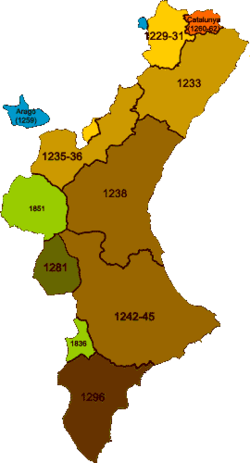

    Christian conquest of the Kingdom of Valencia (brown shades); 19th century additions to the present day Valencian Community (green), do not belong to the historic kingdom; the Biar-Busot line formed the southern border of the kingdom until 1296

    At the end of the process, four taifas had been wiped out: Balansiya, Alpuente, Denia and Murcia. Taking into account the standards of the day, it can be considered as a rather rapid conquest, since most of the territory was gained in less than fifty years and the maximum expansion was completed in less than one century. The toll in terms of social and politic unrest which was to be paid for this fast process was the existence of a large Muslim population within the Kingdom which neither desired to become a part of it nor, as long as they remained Muslim, was given the chance to.


    Modern historiography sees the conquest of Valencia under the light of similar Reconquista efforts by the Crown of Castile: as a fight led by the king in order to gain new territories as free as possible of serfdom to the nobility. The new territories would then be only accountable to the king, thus enlarging and consolidating his power versus that of the nobility. Making it part of a growing trend evident in Spain in the Middle Ages (said to end in 1492 with the final acts of the Reconquista in the capitulation of Kingdom of Granada and the expulsion of the Jews) and well into the era of Habsburg Spain.

    It is under this approach that the repopulation of the Kingdom is assessed today. The new Kingdom population was initially overwhelmingly Muslim and often subjected to revolts and the serious threat of being taken by any given fellow Muslim army put together for this purpose in the Maghreb.

    The process by which the monarchy strove to free itself from any noble guardianship was not easy as the nobility still held a big share of power and was determined to retain it as much as possible. This fact marked the Christian colonization of the newly acquired territories, ruled by the Lleis de Repartiments. Finally the Aragonese nobles were granted several domains but only managed to obtain the inland, mostly mountainous and sparsely populated parts of the Kingdom of Valencia. The king reserved the fertile and highly populated lands in the coastal plains to free citizens and incipient bourgeoisie whose cities were given Furs or royal charters regulating civil law and administration locally, always accountable to the king.

    This had linguistic consequences.:
    Another possibly primary driving force, but likely to be understated by modern historiography, was religious faith. In this regard, Pope Gregory IX recognized the fight as a Crusade and James I was known for being a devout king.

    Height of power


    The Contract Hall in La Llotja de la Seda.
    The Kingdom of Valencia achieved its height during the early 15th century. The economy was prosperous and centered around trading through the Mediterranean, which had become increasingly controlled by the Crown of Aragon, mostly from the ports of Valencia and Barcelona.

    In the city of Valencia the Taula de canvis was created, functioning partly as a bank and partly as a stock exchange market; altogether it boosted trading. The local industry, especially textile manufactures, achieved great development and the city of Valencia turned into a Mediterranean trading emporium where traders from all Europe worked. Perhaps the feature which best symbolises this flamboyant period is the Silk Exchange, one of the finest European examples of civil Gothic architecture and a major trade market in the Mediterranean by the end of the 15th century and throughout the 16th century.

    Valencia was one of the first cities in Europe to install a movable type printing press as per the designs of Johannes Gutenberg. Valencian authors such as Joanot Martorell or Ausiàs March conformed the canon of classic Valencian literature to the Valencian dialect of Catalan.


    In 1479, Ferdinand ascended to the throne as King of Aragon. With his earlier marriage to Queen Isabella I of Castile, the modern Kingdom of Spain was born. Valencia began a slow process of integration with the rest of Spain. When Ferdinand and Isabella's grandson Charles came to the throne, the crowns were permanently joined together in personal union. The kings of Habsburg Spain (January 23, 1516 – November 1, 1700) maintained the privileges and liberties of the territories and cities which formed the kingdom and its legal structure and factuality remained intact. A new position, Viceroy of Valencia, was created to manage the officially independent Kingdom. Meanwhile the rising Spanish Empire had left behind its former status as a Kingdom of the Iberian Peninsula and had emerged as a Great power. The Empire shifted its focus to the Spanish colonization of the Americas and its possessions in Europe, rather than its Iberian territories.

    During the 16th century Valencia lost its status as a preeminent commercial center of Europe to the rapidly developing cities of Northern and Central Europe. Valencia was in frequent conflict with the Ottoman Empire which controlled most of the eastern Mediterranean. They prevented each other from reaching certain ports while Ottoman privateers such as Barbarossa preyed on trade ships. The Barbary pirates such as Dragut, operating out of Tunis, Tripoli, Algiers, Salé and ports in Morocco, attacked shipping in the western Mediterranean, which included destructive raids in Christian ports along the coast. This decline in trade greatly inhibited the economy in Valencia, which had already been economically affected by the Alhambra decree which had expelled the Jews back in 1492.

    In 1519, the young King Charles I granted the Germanies (literally "brotherhoods") permission to arm themselves to fight off the Muslim raiders. The Germanies were artisan guilds who also, at first with the government's permission, served as civilian militias to fight raiding pirates. However, the Germanies also had an economic agenda favoring the commoner-dominated guilds that clashed with the aristocracy. After the recently appointed Viceroy of Valencia Diego Hurtado de Mendoza refused to seat elected officials who favored the Germanies in 1520, a full fledged revolt broke out, the Revolt of the Brotherhoods (Revolta de les Germanies).

    Because of the exhausted forces left by the clashes between nobles and high bourgeoisie versus the general populace and lesser bourgeoisie, the king was able to use the power vacuum to enlarge his share of power and gradually diminish that of the local authorities; this meant that his requests for money in order to enlarge or consolidate the disputed possessions in Europe were progressively more frequent, more imperative and, conversely, less reciprocated for the Kingdom of Valencia.

    Then the expulsion of the Moriscos in 1609 was the final blow for the Kingdom of Valencia, as thousands of people were forced to leave, entire villages were deserted, and the countryside lost its main labor force. In all, some 125,000 people are supposed to have left the land. This expulsion was broadly welcome with the Valencian citizenry, especially for its more popular segments. Since the expulsion meant the loss of a cheap workforce for the nobility, they and the upper bourgeoisie had to turn to the king seeking protection from the general populace, which meant they had to renounce their former check and balance role before the requests of the kings, which was one of the driving forces of the Kingdom's autonomy.

    The Kingdom of Valencia as a legal and political entity was finally ended in 1707 as a result of the Spanish War of Succession. The local population mostly took the side of and provided troops and resources for Archduke Charles, the pretender who was arguably to maintain the legal status quo. His utter defeat at the Battle of Almansa, near the borders of the Kingdom of Valencia, meant its legal and political termination, along with other autonomous parliaments in the Crown of Aragon, as the Nueva Planta Decrees were passed.
    2012-05-02

    FORMER SOVEREIGN STATES OF THE PYRENEAN ISTHMUS (VII).


    COUNTY OF URGELL

    The County of Urgell (Catalan: Comtat d'Urgell, IPA: [kumˈtad durˈʒeʎ]; Latin: Comitatus Urgellensis) is one of the historical Catalan counties, bordering on the counties of Pallars and Cerdanya. The county was carved by the Franks out of a former section of the Mark of Toulouse when the Alt Urgell area became part of the Carolingian Empire between 785 and 790.


    Coat of arms


    The original territory was made up of the Alt Urgell, also known as Urgellet from the end of the 12th century onwards, with the see at La Seu d'Urgell. From 839 onwards it would include 129 villages, the valleys of the Valira river, namely Andorra and Sant Joan Fumat, the Segre riverine area as well as the valleys located between El Pont de Bar and Oliana.


    Its maximal extension territory was between the Pyrenees and the taifa of Lleida, that is, the current comarques of Alt Urgell or Urgellet, Noguera, Solsonès, Pla d'Urgell, Baix Urgell and the still independent country of Andorra. The historical capital was first la Seu d'Urgell and later Balaguer. The county of Urgell was extinguished and absorbed by the County of Barcelona in 1413, after the revolt of the last count, James II of Urgell, against the king Ferdinand I of Aragon.

    There is also a diocese of Urgell. The diocese was an old one, and traditions of the early Christian church lingered; Felix of Urgel's tendencies towards the heretical position of adoptionism was attacked by Alcuin of York in Contra Felicem (Runciman, 1947). Andorra was ceded to the bishop of Urgell by the count Ermengol IV of Urgell in the twelfth century. There is still a bishop of Urgell, who since 2003 has been Joan Enric Vives Sicília. This role carries with it the position of joint head of state of Andorra.

    2012-04-17

    FORMER SOVEREIGN STATES OF THE PYRENEAN ISTHMUS (VI).

    COUNTY OF PALLARS SOBIRA

    The County of Pallars Sobirà or (Pallás) Sobirá meaning Upper Pallars, was a county in the Pyrenean Isthmus during the eleventh and twelfth centuries. It was a division of the County of Pallars, which had been de facto, and possible de jure, independent since the late ninth century. It roughly corresponded with the modern Catalan comarca of Pallars Sobirà.

    Coat of arms of the Counts of Pallars.

    In 1011, Sunyer of Pallars died and by his testament his county was divided between his sons, the eldest, Raymond III, receiving Pallars Jussà and the younger, William II, receiving Pallars Sobirà. Pallars Sobirà comprised the original heartland of the county of Pallars: the upper valley of the Noguera Pallaresa.


    By the year 1000, the economic and social centre of Pallars was located in Pallars Jussà. It was wealthier than Pallars Sobirà and capable of expansion in the Reconquista against the Muslim territory to its south. During the eleventh century, the comital power in Pallars Jussà was violently reduced by the incessant attacks of Artau I of Pallars Sobirà in alliance with Ermengold III of Urgell.

    Because Pallars Jussà was so much richer and populous than the poor and mountainous Pallars Sobirà, the nobles of the latter country designed to eliminate the authority of Raymond IV in the former country. Artau himself was barely a count, rather more like the war leader of a band of powerful feudatories whose objective was the pillage of the wealthier rural communities of the lower territories of Pallars Jussà and the repeal of their rights of tax exemption and other immunities.

    The peasants of Pallars Sobirà were heavily burdened by arbitrary exactions, forced labour, and military service. The barons had the right to exact toltae, forciae, and usatici, that is, "customary levies." In the ensuing war, Raymond IV lost most of his fortresses, including his capital, Segur, to Sobirà. However peace was established between the two countries and Raymond regained his position after Artau's death. Artau's son, Artau II (1081–1124), is recorded as never having fought with his relatives of Pallars Jussà.

    Pallars Sobirà was isolated high in the Pyrenees. and of no importance to affairs in the isthmus on a larger scale. Artau III and Artau IV neither they nor their successors took part in the succession to the county of Pallars Jussà before it passed to the County of Barcelona in 1192. By 1199, Pallars Sobirà was inherited by a woman, Guillelma, who sold her county to her husband, Roger of Comminges, and retired to a convent.